Jr. High
JR. HIGH |
| Curricular program |
The LAF curriculum is based on international educational standards and is strongly supported by reading and writing. The school fosters a love for reading to stimulate imagination, curiosity, and learning.
The goal is for young students to understand, develop critical thinking skills, speak, and write, expressing their ideas and feelings in three languages: English, French, and Spanish.
The school ensures students master English while maintaining the importance of Spanish as a key means of communication.

The school teaches French as a third language with support from IFAL. The institution is the only one in Nuevo León with over 40 years of experience teaching French from toddler to Jr. High.
Classes are taught in mini-lessons:
1.The teacher explains and models
2.The student practices independently
3.The teacher checks for correct understanding.
Academic performance is measured with international standardized tests: MAP (English, Math, Spanish, and Science), TOEFL (English), DELF (French), and Piense II (high school admission exam preparation).
The school receives feedback on graduates' performance from high schools, which allows for continuous innovation and improvement of the LAF Academic Program.
The school maintains close communication with prestigious universities to update its academic programs and ensure students' success in gaining admission.
| LANGUAGES |
 |
 |
 |
| 70% | 20% | 10% |
Subjects in English:
Language Arts
Math
Technology
Geography
History
Biology
Chemistry
Physics
MUNLAF
Art
Civics (Values)
Subjects in Spanish:
Spanish
History
Music
Sports
Subjects in French:
Français
(3 classes per week)
| Reading Program |

In Jr. High grammar and spelling are reinforced through reading.
The school has a variety of classroom libraries that support the reading program:
1.In-Class Libraries: Each classroom from 3rd grade kindergarten to 9th grade has 300-500 books.
2.Digital Platforms: Three platforms, Raz-Kids, Achieve, and Tumblebooks, contain a variety of readings in Spanish, English, and French to supplement the academic program's reading material.
3. Academic Program Libraries: Grade-level reading books used by teachers for lessons. These libraries are aligned with U.S. educational standards.
The books are age-appropriate to create a positive emotional connection and help students learn to read with enjoyment.
| Writing Program |
The program's goal is to develop writers who can express their ideas and feelings. Writing is used to strengthen grammar and spelling.
Students are taught to write in English, French, and Spanish, and are encouraged to recognize the writer within themselves.
A specific time each day is dedicated to writing development.

| Math Program |

Students develop mathematical skills using international methods and curricula, learning different ways to solve problems using logic, not just memorizing concepts.
Concepts are learned in a spiral manner, gradually increasing in complexity, and students are taught to arrive at the same result in different ways.
| Technology Program |
Jr. High, students learn to program websites, video games, and applications using Coding, Python, and HTML.
They also use their Chromebooks daily for presentations, research, and projects to prepare them for their university and professional lives.

| Educational Technology Platforms |

Used from toddlers to 9th grade, this reading platform helps develop skills in reading comprehension, grammar, and mathematics. The collection includes over 1,100 titles in English, Spanish, and French.

This platform provides animated educational resources used in Kindergarten, Elementary, and Jr. High as academic support. It features short, engaging lessons that reinforce learning in subjects like Spanish, English, Science, Art, and Music.

This platform is used in Jr. High to support the reading program. It includes a wide range of informative texts in English and Spanish with comprehension exercises. The platform helps students develop reading comprehension, analysis, and critical thinking skills by providing texts tailored to each student's individual reading level.

IXL has three platforms: Math, Language Arts, and Science. The Math platform is used from Kindergarten to Jr. High to practice topics covered in class. The Language Arts platform is used from 3rd to 9th grade to support the English program. The Science platform is used from 4th to 8th grade to reinforce the Science, Biology, and Physics programs.

This program is used for practicing and mastering basic math operations, including addition, subtraction, multiplication, division, and fractions.

La materia de Science de Primaria se apoya en la plataforma Science A-Z, la cual contiene lecturas científicas que se encuentran al nivel de la comprensión lectora de los alumnos. Esta plataforma integra lecturas de nivel básico, intermedio y avanzado para explicar un mismo tema en cada uno de los grados.

This learning platform supports the academic Technology program. From 4th to 9th grade, the "Coding" platform is used to teach digital programming for developing websites, games, and applications.

This is an online digital book that prepares students to take high school admission exams. Students acquire the skills, knowledge, and tools needed to take any admissions test.

This is a virtual platform that allows teachers and students to securely share notes, homework, and projects online. It also helps parents keep track of their children's performance by letting them view assignments, tasks, and announcements.
| Standardized Test |

Dynamic test aligned to international educational standards that is applied in 146 countries to 565 international schools, to millions of children worldwide. MAP is an individual adaptive test that measures skills in Reading in English and Spanish (1st to 9th grade), Grammar in English (2nd to 9th grade), Mathematics (1st to 9th grade) and Science (4th to 9th grade). The results obtained allow us to know the academic progress of each student and compare it against scores obtained worldwide.

This is a test that measures English language proficiency, focusing on the skills of Reading, Listening, and Grammar.
LAF administers the TOEFL to Secondary students at the beginning and end of each school year.
At the end of 8th grade, students take the TOEFL for Cultural Relations, which issues an official certificate, with average scores ranging from 500 to 600 points.

This is a test aligned with the Academic Aptitude Test (a high school admission exam). It is administered to 8th-grade students and measures skills in:
- Spanish
- English
- Mathematics.

This is a standardized test with international recognition that measures students' proficiency in the French language.
Competencies assessed in the DELF:
- Listening comprehension: Measures the ability to understand spoken messages in French, such as conversations, instructions, or announcements.
- Reading comprehension: Assesses the ability to read and understand short, simple texts.
- Oral expression: Assesses the student's ability to express themselves verbally in French, participate in dialogues, and answer questions.
- Written expression: Assesses the ability to write simple, coherent texts, using grammatical structures and vocabulary appropriate to the level.
As part of the French academic program, students from 3rd to 9th grade take internal evaluations at the beginning and end of each school year. Additionally, 4th, 6th, and 9th-grade students take the official DELF test at the Alliance Française facilities.
DELF Test:
| Grade | DELF Test | Explanation of each Evaluation |
| Nursery, Pre-K, Kindergarten, 1st and 2nd Elementary grades | - | The DELF test is not administered in these grades. The students are learning the basics of the language |
|
3rd grade
|
Prim A1.1
Institutional
|
The student develops the ability to recognize and use very elementary words and expressions. They can understand basic instructions and answer simple questions. They are beginning to read and write short sentences. Present tense |
| 4th grade |
Prim A1
Official
|
The student develops the ability to understand and use simple everyday expressions in French, as well as read and write short texts, which allows them to function in basic daily life situations.
Present tense in simple sentences.
|
| 5th grade |
Prim A2
Institutional
|
The student can communicate simply but effectively in common situations, developing basic skills to interact in French in everyday and predictable contexts.
They use the present and past tense and construct more elaborate sentences. |
| 6th grade |
Prim A2
Official
|
|
| 7th & 8th grade | Jr A2 Institutional |
The student can understand and communicate in French in basic everyday situations, comprehending simple texts and messages, and expressing themselves clearly and simply both orally and in writing. Present, past, imperfect, and future tenses. |
| 9th grade | Jr A2 Official |
| One to One Program |

- Access to diverse learning resources.
- Access to open learning courses.
- Online libraries.
- Authentic and up-to-date information.
- Collaborative learning.
- A multimedia approach to education.
- Distance learning.
- Attractive methodologies and tools.
- Time optimization of routine tasks.
- Learning without schedule restrictions.
- Storage of education statistics.
- Multiple communication channels.
To reinforce the use of knowledge acquired in the technology class, by making creative presentations for their classes in the three languages, preparing them for their university and professional life.

We have the DNS Server service that allows greater control of the information and content on the Internet, consulted by students.
|
MUNLAF Program
|
The Model United Nations, better known as MUN, began as a class project at Berkeley and Harvard universities, with the following characteristics:
- The Model United Nations (MUN) is a simulation of UN sessions.
- Students from various schools or universities participate and represent diplomats from different UN member countries.
- Students are trained on topics related to the culture, domestic and foreign policy, economy, and society of the country they represent.
- They debate and resolve issues that are currently being handled in UN bodies and committees.
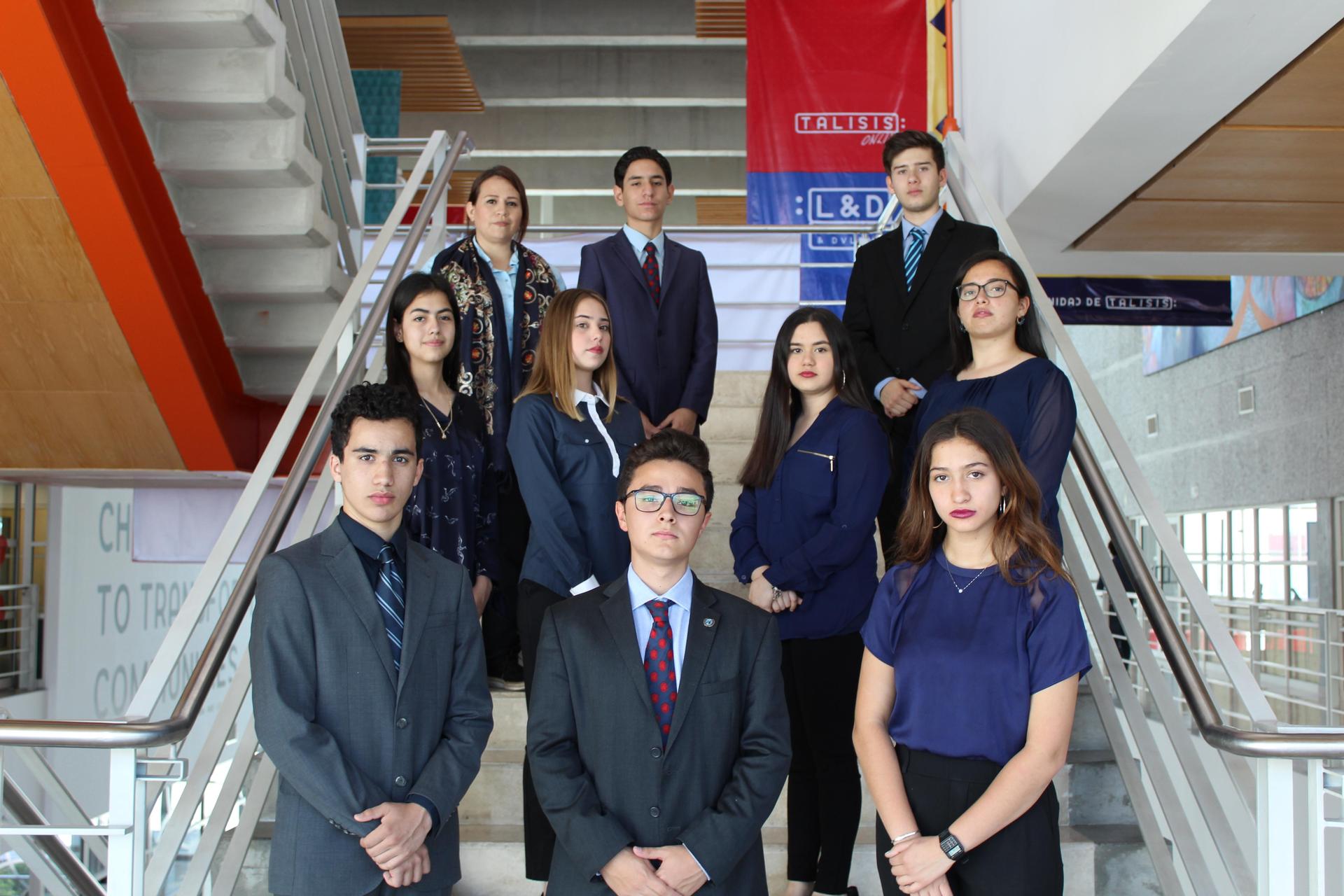
In middle school, MUN was added as a subject because it develops important skills such as research, writing, listening, clear expression of ideas, and the ability to debate while respecting others' ideas.
Students who excel in this program can compete for scholarships at TEC and UDEM.